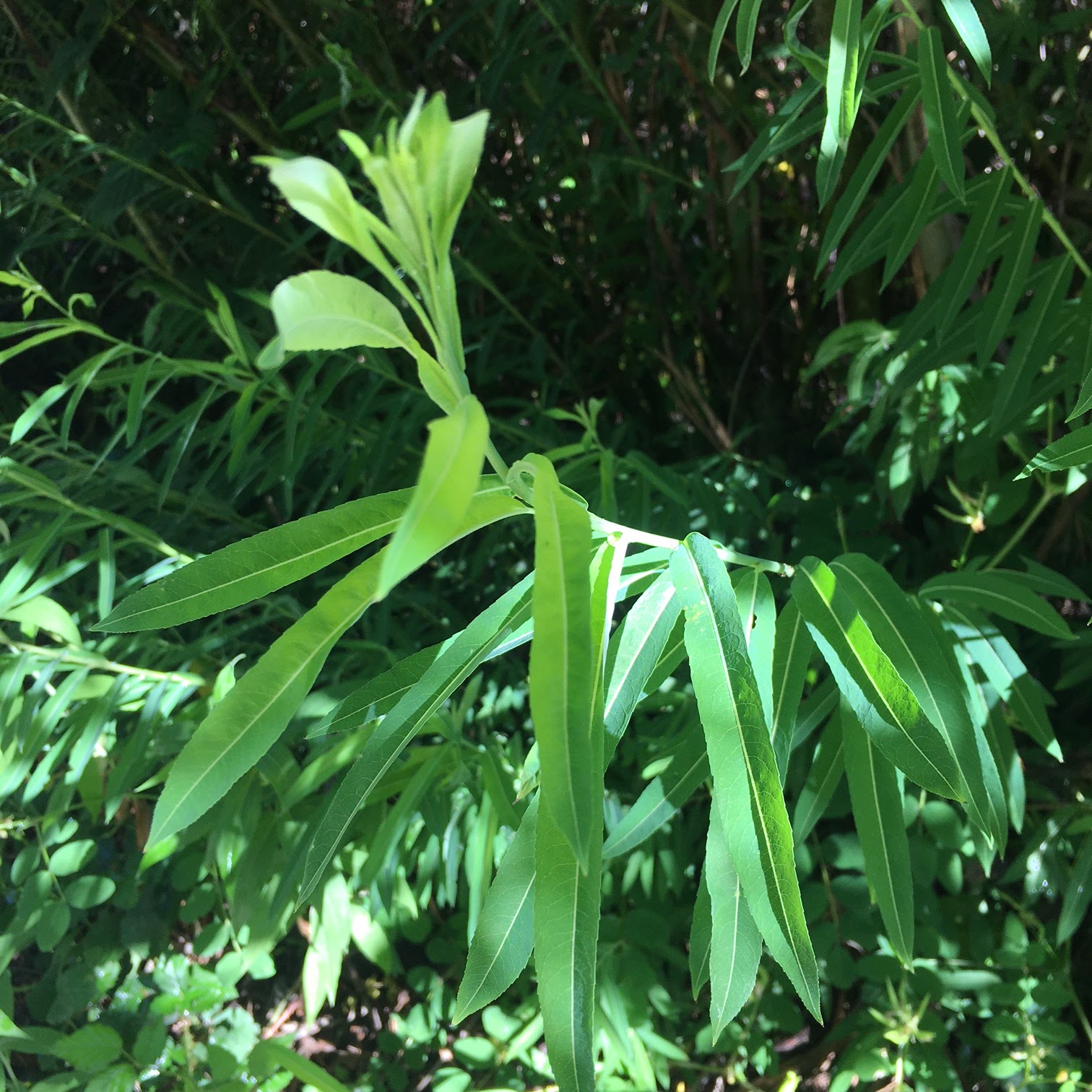
Willow trees usually have lance-shaped leaves, green to silver in colour. Above are some pictures of willows growing by the sides of my daily walking/biking track near my home.
Vse, kar delam z VOLNO - predvsem barvam z rastlinami, filcam, pletem, kvačkam.... pa tudi s SVILO, BOMBAŽEM, pa še kaj drugega zanimivega ... My blog contains my work with WOOL - above all natural dyeing, felting, knitting, crochetting.... and also with SILK, COTTON , and other interesting things off topic ...
Friday, 25 June 2021
Lansko barvanje 2 - Last year's dyeing 2
Willow trees usually have lance-shaped leaves, green to silver in colour. Above are some pictures of willows growing by the sides of my daily walking/biking track near my home.
Friday, 15 May 2020
Sadike indiga - Indigo seedlings
Saturday, 9 February 2013
Navadna krhlika (Rhamnus frangula) - Alder buckthorn
Končno rdečkaste (in oranžne) barve iz skorje krhlike. Krhlika je neugleden grm, ki ga nisem poznala in sem ga zaman skušala najti po slikah iz knjig in interneta. Končno mi je lani poleti Marko Slapnik, direktor Rinke v Solčavi (Rinka Solčava), prijazno prinesel vejico, da sem "in vivo" spoznala ta grm. Potem sem seveda videla, da sem v Robanovem kotu (Robanov kot) vsa leta hodila mimo nje :-(
In po navodilih iz knjižice Helen Melvin (Helen Melvin) naredila barvilno kopel s fermentiranjem (beri: vse bolj smrdljivo, dlje ko sem barvala) začela dobivati prelepe barve.
Na slikah zgoraj je nekaj odtenkov na nekaj različnih volnah.
Fotografirala je pa Kati (ali Katka) v Centru domače in umetnostne obrti v Škofji Loki (DUO Škofja Loka).
Friday, 2 September 2011
Prodajala bom svojo rastlinsko barvano volno na šuštarski nedelji v Tržiču
Uporabljam samo volno od naših ovc jezersko-solčavske pasme, ki imajo od slovenskih ovc najmehkejšo volno. Ovčke se vse poletje pasejo visoko v planinah, tudi do 2000 metrov nad morjem, pozimi pa jih krmijo s senom s planinskih travnikov, zato je njihova volna ekološka. Oprana je z vodo in barvana z rastlinami, ki rastejo pri nas. Vse to ji daje poseben čar in vrednost.
Ima tudi certifikat Obrtno-gospodarske zbornice Slovenije, da je izdelek domače obrti. Ni v prodaji v trgovinah, zato si jo pridite pogledat - in morda kupit - na “štant” na šuštarski nedelji :-)
Thursday, 9 June 2011
(Spet) šentjanževka in zeleni orehi (spet) - (Again) St. John's wort and green walnuts (again)
... tokrat pa skupaj. Zaželela sem si teh dveh mojih priljubljenih materialov na isti štreni volne. Barvanja sem se lotila s posušenimi cvetovi šentjanževke in svežimi zelenimi orehovimi lupinami. Ker je bilo materiala veliko, so barve močne, presenetila pa me je zamolklost šentjanževkine barve: no, čisto sem spregledala, da posušene dajo te zamolkle barve, računala pa sem na sveže barve šentjanževke in temne orehove. Saj ne rečem, da mi ne bi bile všeč...
... together this time. I wished to produce the colours of my two favourite dyeing materials on the same skein of wool. I set to dyeing with dried St. John's wort flowers and fresh green walnut hulls. I had plenty of material so the colours are intense but the dullness of St. John's wort colours surprised me. Well, I quite forgot that the dried flowers give these dull colours, I had fresh, more pastel St. John's wort colours in mind, combined with intense dark walnut . I can't say I don't like them though...
Saturday, 23 April 2011
Vesele velikonočne praznike - Happy Easter
Thursday, 8 July 2010
Šentjanževka je carica - St. John's wort rules
Spet sem nabirala cvetje šentjanževke - na maminem vrtu, ob poljskih poteh, na travnikih, v hribih, na zapuščenih zaraslih zemljiščih... Letos sem jih dobila izredno veliko in sem tudi barvala z njimi izredno veliko. Na volni sem dobila standardne barvne serije zeleno-vijolično-rjavo-zlato rumeno-limonino rumeno, z vršički s popki tik pred začetkom cvetenja pa tudi izjemno oranžne odtenke.
I collected St. John's wort flowers again - in Mum's garden, along field paths, in meadows, in the mountains, in waste areas... This year I got extreme quantities and also did extremely much dyeing with it. On wool it gave the standard colour series green - violet-brown - golden yellow - lemon yellow, but also extraordinary orange hues with tops with buds just prior to blooming.
Ker sem imela tako veliko materiala, sem se odločila za eksperimentiranje. Posebej sem barvala s cvetki (in popki), posebej z zeljo-listki in posebej z oskubljenimi stebli. Presenečena sem ugotovila, da barvilo vsebujejo prav vsi deli (samo korenina ne, kar sem ugotovila lani), seveda pa ga je zdaleč največ v cvetkih, skoraj nič manj v popkih, tudi zel ima precej barvila, pa celo oskubljena stebla. Kdo bi si mislil! Pa sem mislila, da so samo cvetki kaj vredni za barvanje. Na spodnji sliki je volna, barvana samo z zeljo. Realna barva je bolj v zgornjem delu slike oziroma, bolje rečeno - volna sploh ni lisasta, ampak lepo enakomerno obarvana.
Since I had so much material at hand I decided to experiment. I used separately flowers (with buds), separately the green parts without stems, and separately stems without flowers or leaves. I was surprised to find out that all the parts of the plant contain the dyeing substance (with the exception of roots, hich I found out last year), flowers being the richest in it, of course. The buds are almost as rich in dye, the leaves also contain much dye, and even the bare stems have some. Who would have thought it! And I was led to believe only the flowers are worth using for dyeing.
The picture below shows wool yarn dyed with green leaves only. The colour is more realistic in the upper section of the picture - or, to be more precise, the yarn is not variegated, the colour is solid.
Nato sem se pogumno lotila barvanja bombažne preje za pletenje in vezenje ter bombažne in lanene prejice za klekljanje. Za to nisem nikjer dobila nobenih navodil, pa imam kar nekaj knjig o barvanju z rastlinami. Nekaj prejice za klekljanje sem barvala s šentjanževko že prejšnja leta, pa sem dobila tako različne rezultate, da nisem vedela, pri čem sem.
In me je res hudo presenetila. Medtem ko na volni po navadi daje standardne barvne serije, je na bombažu in lanu povsem nepredvidljiva.
Najbolj me je zanimala barva prve kopeli, ki na volni daje tako lepo zeleno. Na bombažu in lanu daje vse od zlato zelene, močne rumene, modrikasto zelene (prva slika levo), sive (druga slika desno).
I was encouraged and tackled dyeing cotton yarn for knitting and stitching and cotton/linen yarn for bobbin lace. I 'd found no instructions or description although I do possess a few books on natural dyeing. I had dyed some yarn for bobbin lace in previous years only to get results that were so inconsistent that left me perplexed.
I was perplexed again. While it yields standard colour sets on wool St. John's wort is quite unpredictable on cotton and linen.
I was mostly interested in the first dyeing in fresh dyeing bath that gives such a lovely green on wool. And what does it give - or at least gabe me - on cotton and linen: everything from golden green, intense yellow, bluish green (first pisture left corner) and grey (secong picture right corner).
Tudi barva kopeli se je letos obnašala čudno - pri eni seriji je po prvem barvanju z galunom čimžane preje kopel postala zelene barve in je taka ostala ves čas, pa sem pomakala in namakala kar precej prejic. Druga kopel, tudi prvo kuhanje samo cvetkov, pa ne !?!
The colour of the dyeing bath itself also behaved in a strange way this year: in one batch it turned green after the first dyeing of alum mordanted yarn and remained green throughout the dyeing session, and believe I did dip and soak and cook many a little skein of yarn. The other byth, also obtained by the first cooking of flowers only did not shift to green !?!
No, roke sem imela pa takele - ampak to nič ne boli in nič ne škodi in se v enem dnevu izmije.
And my hands looked like this - I didn't mind, it doesn't hurt nor damage the skin and is washed off within one day.
To še ni konec dosedanjega eksperimentiranja, ampak blog je že tako predolg, se bojim, da mi jo bo blogger kaj zagodel, zato raje objavim...
This is not yet an end to my experimentation - only my writing is too long already and I'm afraid the Blogger may play a nasty trick on me so I'm posting it...
Thursday, 24 June 2010
Indigo modri metuljček - Indigo blue butterfly
Končno sem se odločila, da uporabim nekaj prelepe modre volne za filcanje. Tomažu sem za 40-letnico naredila metuljčka iz dveh modrih, ki sem ju pobarvala januarja letos, pa še malo svilenih vlaken, nepobarvanih. Za metulja sem si naredila model, ker nisem želela sterilnih geometrijskih oblik. Naredila sem mu celo tipalke, da se ne izgubi...
I eventually decided to use some of the beautiful blue carded wool for felting. I felted a butterfly for Tomaž's 40th birthday. I used two blues I had dyed in January this year, and some silk fibers, undyed. To make the butterfly I had drawn a template because I didn't want any sterile geometric shapes. I even provided it with tentacles so it wouldn't get lost ...
Wednesday, 12 May 2010
Bombažna preja, barvana z rastlinami - Cotton thread, natural dyed

Za spremembo sem barvala bombažno prejo za vezenje in za klekljanje, v barvilni kopeli in kot vrvico za prevezovanje zavitkov pri rastlinskem tiskanju. Nekaj barve je od čebulnih listov, pa od bakrene žice v kisu, svežih rabarbarinih listov, izrabljene košeniljke ...
Navitje prejice se mi zdi pa tako lepo, da sem ga kar morala slikati :-)
For a change, I set to dyeing cotton yarn for stitching and bobbin lace, both in dyeing baths and yarn used for tying rolls in plant printing. Some are dyed with onion skins, others with vinegar in which copper wire had been soaking, then fresh rhubarb leaves, cochineal exhaust, ...
I find the coiled up yarn so beautiful that I just couldn't help taking some photos :-)
Sunday, 11 April 2010
Barvanje s čebulnimi lupinami - Onion skins dyeing
Rdeča čebula, prvo kuhanje, prvo barvanje; čimža - galun, rabarbarini listi, galun po barvanju (od leve proti desni)
Red onions, first dye bath, first simmering; mordants: alum, rhubarb leaves, post-mordanted with alum (left to right)
Rdeča čebula, prvo kuhanje, drugo in tretje barvanje; čimža - galun
Red onions, first dye bath, second and third simmerings; mordant: alum
Rdeča čebula, drugo kuhanje, liste sem pustila v vodi; prvo, drugo in tretje barvanje, čimža - galun
Red onions,second dye bath, with skins left in the pot: first, second and third simmering: red onions, mordant: alum
Yellow onions, first dye bath, second and third simmerings; mordant: alum
Saturday, 3 April 2010
Veselo veliko noč! - Happy Easter!
Vstal je Kristus, upanje moje, aleluja!
Vesele velikonočne praznike želim vsem obiskovalcem!
Christ my hope has risen! Alleluia!
Wishing a happy Easter holiday to all visitors of my blog!
Sunday, 28 March 2010
Indigo
Končno sem se lotila tudi naravnega barvanja z indigom. Dobila sem ga od Alje, ki je nekoč mislila, da bo tudi barvala z rastlinami, potem se je pa usmerila bolj v filcanje in me prosila, če kaj pobarvam še zanjo. Delala sem po receptu iz knjige J. N. Liles: The Art and Craft of Natural Dyeing. Celo leto sem prebirala Lilesove recepte, pa objave na blogih Leene Riihelä, Jenny Dean in Helen Melvin, uživala v njihovih fotografijah in opisih, januarja sem se pa le lotila tega smrdljivega opravila. Rezultat je vreden napora, prav gotovo se bom barvanja z naravnim indigom še lotila.
Zdaj pa na rdeče barve - barvilni brošč (Rubia tinctorum) že vabi!
I finally set myself to dyeing with natural indigo I had been given by Alja - she'd intended to do some natural dyeing but then turned mostly to felting and asked me to do some indigo dyeing also for her. I proceeded according to Liles "Good Old Sig Vat" recipe no. 1. I was re-reading Liles' recipes, posts on the blogs of Leena Riihelä, Jenny Dean and Helen Melvin for one entire year, enjoying in their descriptions and pictures. In January I finally set an indigo vat (smelly, sigh). The result is well worth the effort (and nasal suffering), I'll sure make another indigo vat some day.
And now for the reds - madder is calling!
Sunday, 28 February 2010
Borovnice in šentjanževka - Blueberries and St. John's wort
Le kje se mudi pomlad??!! V moji vazi je takorekoč že poletje, saj borovnice ne samo zelenijo, ampak tudi že cvetijo - tile mali snežnobeli cvetki so borovnice, ki so vzcvetele v cvetličarskem šopku od začetka februarja.
But where is spring lingering??!! There is summer in my vase, so to say, since the bluberries are not only leafy but already in flowers - the small snowwhite flowers are blueberries that started to bloom in a florist bouquet since beginning of February.